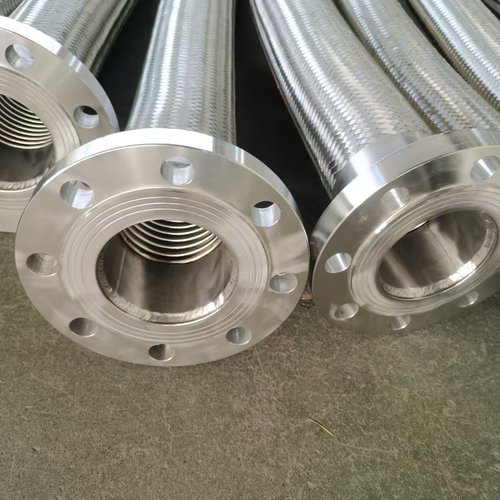
Choosing between SS304 and SS316 is the single most common question we get from buyers specifying a corrugated stainless steel flexible hose. The honest answer is that for a large share of industrial duty, SS304 does the job at a lower price. The mistake is assuming that is always true.
Here is what actually changes between the two grades, and how to decide.
What Changes Between the Grades
SS304 (EN 1.4301) is the standard austenitic stainless steel: roughly 18–20% chromium and 8–10.5% nickel. It resists oxidation and a wide range of mildly corrosive media, and it is the workhorse material for hose, braid and fittings.
SS316 and its low-carbon variant SS316L (EN 1.4404) contain the same base chemistry plus 2–3% molybdenum. That single addition is what buys resistance to chlorides — pitting and crevice corrosion in particular.
One point that gets overlooked: a flexible metal hose is not one material, it is three. The corrugated core, the wire braid, and the end fittings can each be specified separately. A 316 core paired with a 304 braid gives you 316 performance on the wetted surface and 304 performance on the outside, which is often exactly right. Specifying all three explicitly, rather than writing "stainless steel" on the enquiry, prevents most material disputes later.
Corrosion Resistance in Practice
SS304 handles fresh water, steam, hydraulic oil, lubricants, compressed air and most indoor industrial atmospheres without trouble. It is the right answer for the majority of general-purpose hose assemblies.
SS316 is the grade to reach for when chlorides are present. Seawater and marine atmospheres, coastal installations, chloride-bearing process fluids, many organic and inorganic chemicals, and washdown environments all justify the upgrade.
Two caveats worth stating plainly. First, neither grade is suitable for strong chlorides combined with elevated temperature; that combination attacks even 316 and calls for a higher alloy. Second, if the hose is wrapped in insulation or sits in a crevice where chlorides concentrate and oxygen is limited, 304 can pit even in a nominally mild environment.
Temperature Limits
For a standard SS304 corrugated core with an SS304 braid, published service ranges typically run from about −196°C up to roughly 400°C. The exact figure depends on the braid material, the fittings and the media, so the assembly rating is what matters, not the strip rating.
- Above roughly 400–600°C, sensitisation becomes a concern and titanium-stabilised SS321 is usually the better choice. This is the same reason SS321 shows up in heavy truck and engine exhaust flexible pipe.
- At the cold end, cryogenic service such as liquid nitrogen or LNG calls for a specifically designed low-temperature construction, not just a different grade number.
Pressure Rating Comes from the Braid
Buyers often assume the grade sets the pressure rating. It does not. Working pressure is driven mainly by the braid: one braid, two braids, or multi-layer construction, plus the wall thickness of the corrugated core. A 304 hose with three braids will out-pressure a 316 hose with one.
So when you ask for a quotation, send the full picture rather than a grade alone.
Cost
SS316 typically carries a premium over SS304 in the region of 20–35%, depending on diameter, braid configuration and end fittings. That premium is easy to justify when chlorides are present. When they are not, it is money spent on nothing.
| Service environment | Recommended grade | Reason |
|---|---|---|
| Fresh water, steam, oil, compressed air, indoor plant air | SS304 | Adequate resistance, lowest cost |
| Coastal or marine atmosphere, seawater exposure | SS316 | Molybdenum resists chloride pitting |
| Chloride-bearing process media, chemical transfer | SS316 or SS316L | Pitting and crevice resistance |
| Food, pharmaceutical, high-purity transfer | SS316L | Low carbon, easier to clean, weld-friendly |
| Hot exhaust above roughly 400°C | SS321 | Titanium stabilisation resists sensitisation |
| Cryogenic media such as liquid nitrogen or LNG | Low-temperature construction | Grade alone is not enough |
What to Include in Your Enquiry
Send these and you will get an accurate quotation the first time:
- Nominal bore and overall length, including the end fitting type.
- Media, concentration and whether chlorides are present.
- Working pressure, and the burst or safety factor you need.
- Continuous operating temperature and any peak excursions.
- Movement the hose must absorb: vibration, axial, lateral or angular.
- Grade for core, braid and fittings separately.
- Any certification requirement, such as material certificates or third-party inspection.
If you are unsure on any line, tell us the application instead and we will propose a configuration with the reasoning shown, so you can see why each grade was chosen.
Hengshui Zhongsong Flexible Hose Co., Ltd — manufacturer of stainless steel corrugated flexible hose, PTFE hose, exhaust flexible pipe, hammer unions and rubber expansion joints. Send us your line conditions through the enquiry form and we will confirm the right configuration.