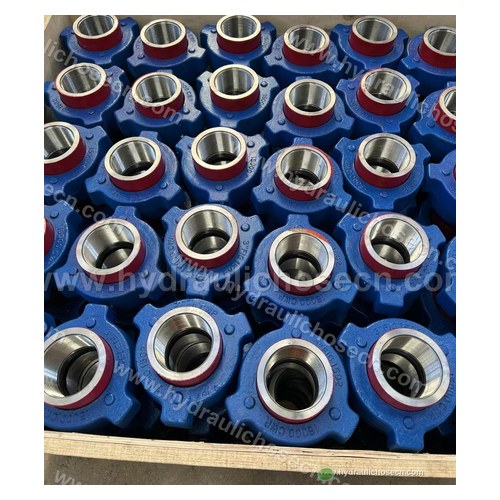
The figure number on a hammer union tells you two things: its pressure rating and its dimensional standard. Two unions with different figure numbers are not interchangeable, even when the nominal size looks the same.
Pressure ratings by figure number
• Fig 100 — 1,000 psi: low-pressure water and air lines
• Fig 206 — 2,000 psi: oilfield service lines, mud, water, cement
• Fig 300 — 3,000 psi: medium-pressure manifolds
• Fig 400 / 402 — 4,000 psi: well service, cementing
• Fig 600 / 602 — 6,000 psi: high-pressure manifolds
• Fig 1002 — 10,000 psi: high-pressure service lines
• Fig 1502 — 15,000 psi: fracturing, wellhead, high-pressure lines
• Fig 2002 — 20,000 psi: ultra-high-pressure service
Fig 206: the medium-pressure workhorse
Fig 206 is rated at 2,000 psi and is the most common union on oilfield service lines, water and mud systems, and general transfer duties. It is normally supplied with threaded ends and is the most economical option in the range.
Fig 1502: the high-pressure standard
Fig 1502 is rated at 15,000 psi working pressure and tested well above that. It is the standard choice for fracturing lines, wellheads and high-pressure manifolds, usually in 2 inch and 3 inch sizes with a wing nut for fast make-up.
Seals and threads
The seal material often decides the service life, not the union body. Buna-N (NBR) covers water, oil and general duty. Viton (FKM) is used for higher temperatures and aggressive media. PTFE and polyurethane are chosen for chemical resistance and abrasion respectively. Thread forms and end connections — NPT, BSP, butt weld or integral — should match the line they connect to.
A common and expensive mistake
Specifying Fig 1502 on a low-pressure water line. The union costs several times more than a Fig 206, and the extra pressure rating buys nothing. The reverse error is far more serious: a Fig 206 on a 10,000 psi line is a safety failure, not a cost issue.
What to send with your inquiry
• Working pressure, and any pressure surges
• Medium and working temperature
• Size and thread or end connection
• Seal material, if you have a preference
• Any certification or standard your project requires
Send us your specification and we will confirm the right figure, seal and end connection before production.
Which figure number do you use most often on your service lines — and have you ever found a mismatch after delivery?